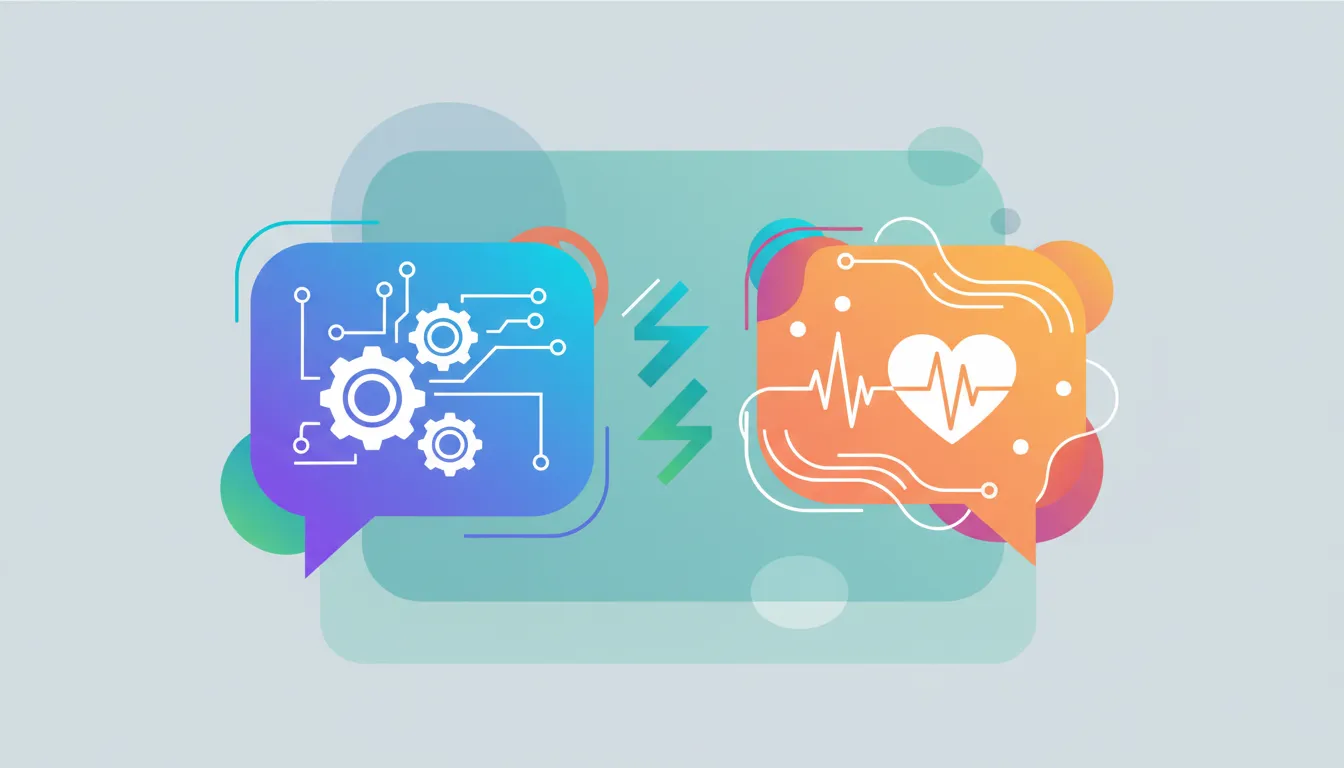
Your website visitors expect instant answers. Whether they are asking about pricing, checking order status, or troubleshooting a problem, they want a response now — not in an hour, not tomorrow, and definitely not after submitting a ticket and waiting for an email. The question is not whether to offer real-time chat on your website. The question is how to offer it: with AI chatbots, with live human agents, or with some combination of both.
This is not a simple decision. Both AI chatbots and live chat have genuine strengths, genuine limitations, and specific scenarios where they outperform the other. At Camfirst Solutions, we have built both AI chatbot systems and live chat implementations for businesses across industries, and the right answer is always “it depends” — but it depends on factors you can clearly evaluate.
This article provides an honest, detailed comparison so you can make the right choice for your business.
What We Mean by AI Chatbot and Live Chat
Before comparing them, we need to define what we are actually discussing, because these terms are used loosely in the market.
AI chatbot refers to a software system that uses artificial intelligence — specifically natural language processing and, increasingly, large language models — to understand visitor messages and generate relevant responses without human involvement. Modern AI chatbots can handle multi-turn conversations, understand context, access business data, and resolve many customer issues independently.
Live chat refers to a system where a human agent communicates with website visitors in real time through a chat interface. The visitor types a message, and a person — your employee or an outsourced agent — reads it and types a response.
Many businesses use hybrid systems that start with an AI chatbot and escalate to a human agent when needed. We will cover that approach as well, but first, let us examine each option on its own merits.
Response Time and Availability
AI Chatbot
An AI chatbot responds instantly, typically within one to two seconds, regardless of time of day, day of week, or concurrent visitor volume. At 2 AM on a Sunday with 50 visitors asking questions simultaneously, every single one gets an immediate response. There is no queue, no hold time, and no “We’ll be back Monday” message.
Live Chat
Live chat response times depend entirely on agent availability. During staffed hours with adequate coverage, initial response times typically range from 30 seconds to three minutes. During peak periods, waits can extend to five or ten minutes. After hours, most businesses either disable live chat entirely or display a “leave a message” form.
The average live chat agent handles two to three simultaneous conversations effectively. Beyond that, quality degrades as agents juggle too many threads and response times stretch.
Verdict
AI chatbots win on response time and availability. The gap is not close. If immediate, round-the-clock response is a priority — and for most businesses, it should be — this is a significant advantage.
Quality of Responses
AI Chatbot
Modern AI chatbots powered by large language models produce surprisingly high-quality responses for well-defined topics. They can explain product features, walk through troubleshooting steps, provide pricing information, and answer frequently asked questions with accuracy and clarity.
Where AI chatbots struggle is with ambiguous questions, highly specific edge cases, and situations that require judgment or creativity. If a visitor asks something the AI has not been trained on or that falls outside its knowledge base, the response may be generic, incorrect, or unhelpful.
The quality floor is high (every response meets a minimum standard) but the quality ceiling is limited (the AI cannot match an expert human for nuanced, complex interactions).
Live Chat
Human agents can understand nuance, read between the lines, exercise judgment, and adapt their communication style to the individual visitor. A skilled agent can handle a frustrated customer with empathy, navigate an unusual situation creatively, and build genuine rapport.
However, human quality is inconsistent. It depends on the agent’s training, experience, mood, workload, and familiarity with the topic. The quality ceiling is very high with the best agents, but the quality floor can be very low with new, undertrained, or overworked agents.
Verdict
Live chat wins for complex, nuanced, and emotionally charged interactions. AI chatbots win for consistency and accuracy on well-defined topics. The practical question is what percentage of your conversations fall into each category.
Cost Comparison
AI Chatbot
The cost structure for AI chatbots includes:
- Setup and development: $5,000 to $30,000 for a custom AI chatbot with proper integration, or $50 to $500 per month for a SaaS chatbot platform with limited customization
- Monthly platform and API costs: $200 to $2,000 per month depending on conversation volume and complexity
- Maintenance and optimization: 5 to 15 hours per month of internal or external specialist time
The cost per conversation typically falls between $0.10 and $1.00, regardless of volume. The marginal cost of handling one more conversation is negligible.
Live Chat
The cost structure for live chat includes:
- Agent compensation: $15 to $25 per hour for in-house agents, or $8 to $15 per hour for outsourced agents
- Platform cost: $20 to $150 per agent per month for chat software
- Management and quality assurance: supervision, training, and performance monitoring costs
With a typical agent handling 150 to 250 conversations per day, the cost per conversation ranges from $3 to $10. Staffing 24/7 coverage requires a minimum of four to five full-time agents, which represents $180,000 to $300,000 in annual compensation before platform costs, management, and overhead.
Verdict
AI chatbots cost dramatically less at scale. A business handling 5,000 chat conversations per month might spend $500 to $1,500 with an AI chatbot versus $15,000 to $30,000 with live chat agents providing equivalent hours of coverage. Our AI chatbot development service helps businesses achieve these cost efficiencies without sacrificing conversation quality.
Scalability
AI Chatbot
AI chatbots scale infinitely with minimal cost increase. Whether you have 10 concurrent visitors or 10,000, the experience is identical. Seasonal traffic spikes, marketing campaign surges, and viral moments are handled without any planning, hiring, or overtime.
Live Chat
Scaling live chat requires hiring and training additional agents. This takes weeks or months and creates a staffing challenge: you either overstaff for peak periods (wasting money during quiet times) or understaff for peaks (delivering poor service when demand is highest). Outsourced agents can provide some flexibility, but quality control becomes more difficult.
Verdict
AI chatbots win decisively on scalability. If your business experiences variable traffic volumes, this advantage alone may justify the choice.
Personalization and Context
AI Chatbot
When properly integrated with your CRM and business systems, an AI chatbot can greet returning visitors by name, reference their purchase history, check their order status, and tailor recommendations based on their browsing behavior. This data-driven personalization happens automatically on every conversation.
However, AI personalization is data-dependent. It requires good system integration and clean customer data. Without these foundations, the AI has limited context to work with.
Live Chat
Human agents can personalize conversations intuitively — picking up on tone, asking exploratory questions, and adapting their approach based on subtle cues. An experienced agent can often identify what a customer really needs even when they struggle to articulate it.
The limitation is that human personalization requires the agent to look up information manually, which takes time and depends on the agent knowing where to find it. Agents handling multiple conversations simultaneously may not have time for deep personalization.
Verdict
Both approaches offer personalization, but through different mechanisms. AI chatbots offer consistent, data-driven personalization at scale. Human agents offer deeper, intuitive personalization for individual conversations. The best approach depends on whether your customer interactions benefit more from data access or human intuition.
Handling Complex Issues
AI Chatbot
AI chatbots handle complex issues well when the complexity is informational — explaining complicated products, walking through multi-step processes, or comparing options across multiple dimensions. They can access and synthesize large amounts of information quickly.
They struggle with complexity that requires judgment: interpreting ambiguous policies, making exceptions, negotiating, or handling situations not covered by existing documentation.
Live Chat
Human agents excel at complexity that requires judgment, empathy, and creative problem-solving. They can interpret situations, make judgment calls, escalate internally, and find solutions that no pre-defined process anticipated.
Verdict
Live chat is better for complex, judgment-dependent issues. AI chatbots are better for information-complex but process-simple interactions.
Customer Satisfaction
Customer satisfaction research reveals a nuanced picture.
Studies from 2025 and 2026 show that customer satisfaction with AI chatbots has increased significantly as the technology has improved. When AI chatbots resolve issues quickly and accurately, satisfaction scores are comparable to or higher than live chat. The key driver is resolution — customers care more about getting their problem solved than about who or what solves it.
However, satisfaction drops sharply when AI chatbots fail to understand the question, provide irrelevant answers, or make it difficult to reach a human. The worst customer experience is an AI chatbot that cannot help but will not let you talk to a person.
For live chat, satisfaction correlates strongly with response time and resolution speed. Long waits erode satisfaction regardless of how helpful the agent eventually is.
The takeaway: both approaches can achieve high satisfaction, but both can also deliver terrible experiences. Implementation quality matters more than the technology choice itself.
Data and Analytics
AI chatbots automatically log, categorize, and analyze every conversation, giving you structured data on common topics, resolution rates, drop-off points, and sentiment trends in real time. Live chat generates transcripts but extracting structured insights requires additional effort and tooling. AI chatbots win on analytics capability, which matters significantly for data-driven optimization.
The Hybrid Approach: Why Most Businesses Should Use Both
After evaluating all of these factors, the conclusion for most businesses is not either/or — it is both. A hybrid approach uses AI chatbots as the first line of interaction and escalates to human agents when the situation warrants it.
How Hybrid Works
- The AI chatbot greets every visitor and handles the initial interaction.
- For routine questions and requests, the AI resolves the issue completely.
- When the AI detects a complex issue, negative sentiment, or an explicit request for a human, it transfers the conversation to a live agent.
- The live agent receives the full conversation history and any data the AI has already gathered.
- The human agent resolves the issue with full context, without making the customer repeat anything.
Benefits of Hybrid
- Cost efficiency. The AI handles 60 to 80 percent of conversations, reducing the number of human agents needed.
- Better human interactions. Human agents focus on the conversations where they add the most value, leading to higher job satisfaction and better outcomes.
- 24/7 coverage. The AI provides instant support around the clock, with human agents available during business hours for escalated issues.
- Continuous improvement. Conversations the AI cannot handle reveal knowledge gaps and training opportunities that improve the system over time.
For a deeper look at the platforms that support this hybrid model, see our guide to the best AI chatbot platforms in 2026.
Decision Framework: Which Approach Is Right for You?
Choose AI Chatbot Only If:
- Your chat volume is high and your budget for human agents is limited
- Most of your conversations are informational and routine
- You need 24/7 coverage but cannot afford round-the-clock staffing
- Your products and services are well-documented and relatively straightforward
- You are comfortable with callers not being able to reach a human through chat (they can still call or email)
Choose Live Chat Only If:
- Your chat volume is low (under 50 conversations per day)
- Your conversations are primarily complex, consultative, or emotionally sensitive
- Your competitive advantage depends on human relationships and personal service
- You have the staffing and budget for consistent, high-quality agent coverage
Choose a Hybrid Approach If:
- Your chat volume includes a mix of simple and complex conversations
- You want 24/7 coverage without 24/7 human staffing costs
- You value both efficiency and the ability to provide human support when needed
- You want to scale your chat capacity without proportionally scaling your team
Most businesses with moderate to high chat volume will find the hybrid approach delivers the best balance of cost, quality, and coverage.
Implementation Considerations
For AI chatbot implementation, invest in thorough knowledge base development, design flows based on real customer questions, and plan for ongoing optimization. Our AI chatbot development service handles the entire lifecycle. For live chat, hire agents trained specifically for chat, enforce response time standards, and define clear operating hours. For hybrid, start with AI and add human escalation once it handles routine conversations reliably, ensuring seamless context transfer between AI and human agents.
If your website needs a redesign to incorporate chat effectively, our web development team can help. You can also enhance your chat system with AI voice calling for customers who prefer phone conversations.
Making Your Decision
The choice between AI chatbot and live chat is not about which technology is objectively better. It is about which approach matches your business context: your customer expectations, your conversation complexity, your budget, your staffing capacity, and your growth trajectory.
The good news is that you do not have to get it perfect on day one. Start with the approach that makes the most sense for your current situation, measure results, and iterate. Many businesses start with a basic AI chatbot, learn from the conversations it cannot handle, and gradually build a sophisticated hybrid system.
For practical guidance on building an AI chatbot from scratch, our tutorial on how to build an AI chatbot for customer support walks through the entire development process step by step.
At Camfirst Solutions, we help businesses evaluate their options, implement the right solution, and optimize it over time. Whether you need a standalone AI chatbot, a live chat setup, or a hybrid system, our team has the experience to get it right.
Ready to add intelligent chat to your website? Contact us for a consultation tailored to your specific business needs.