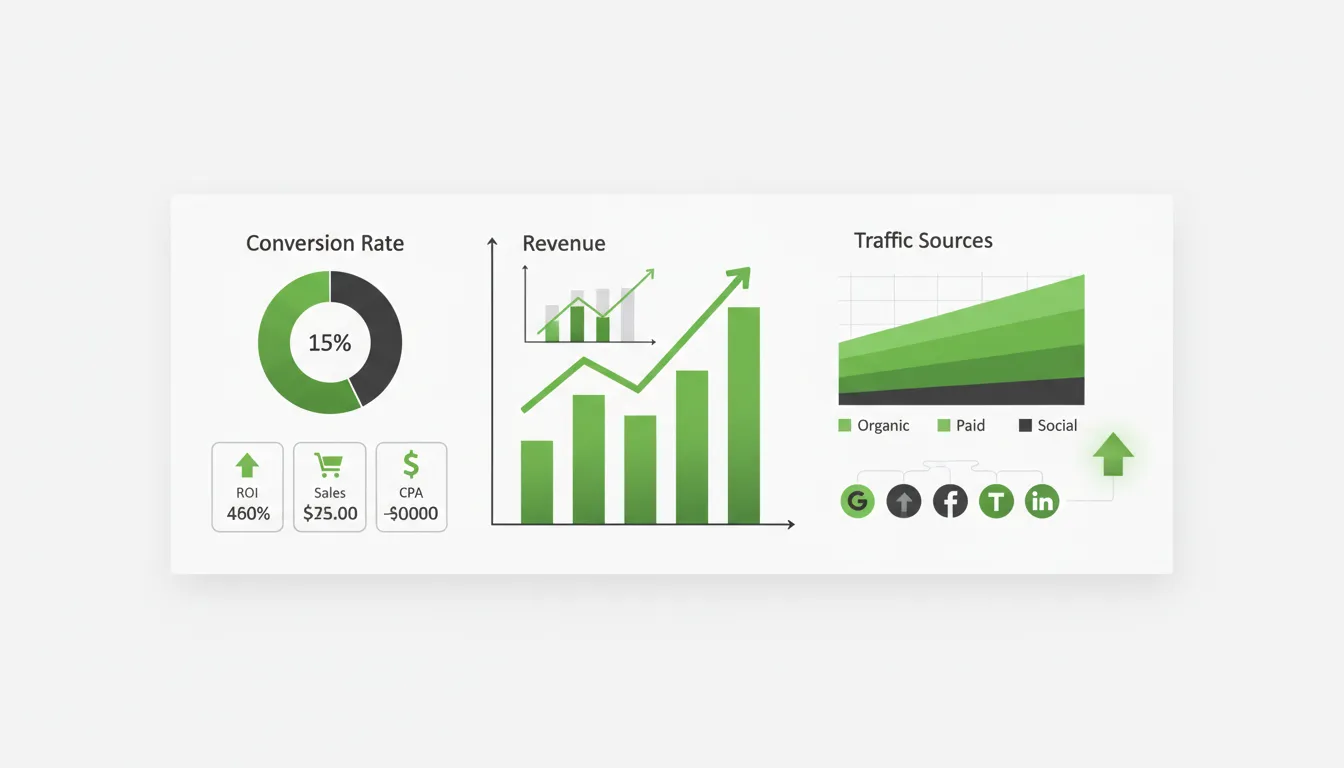
Every dollar you spend on digital marketing should contribute to measurable business outcomes. Yet many businesses struggle to connect their marketing spend to actual revenue, making it difficult to know which campaigns deserve more investment and which should be scaled back. At Camfirst Solutions, we help businesses build data-driven marketing strategies that deliver transparent, trackable returns. Understanding how to measure digital marketing ROI is not just a reporting exercise — it is the foundation of smarter budget allocation and sustainable growth.
Defining ROI for Digital Marketing
At its simplest, marketing ROI is calculated as:
ROI = (Revenue from Marketing - Cost of Marketing) / Cost of Marketing x 100
If you spend $10,000 on a campaign that generates $40,000 in revenue, your ROI is 300 percent. However, applying this formula in practice is far more nuanced than it appears.
Digital marketing operates across multiple channels, touchpoints, and time horizons. A customer might discover your brand through an organic search result, engage with a social media post weeks later, click a retargeting ad the following month, and finally convert through an email campaign. Attributing that conversion — and the associated revenue — to a single channel oversimplifies reality.
Effective ROI measurement requires clear definitions of what constitutes a “cost” and what qualifies as “revenue” or “value” for your business. Direct e-commerce sales are straightforward to track, but lead generation, brand awareness, and customer retention campaigns require proxy metrics that tie back to revenue over time.
Key Metrics by Channel
Each digital marketing channel has specific metrics that indicate performance and contribute to overall ROI calculations. Here are the most important ones to track.
SEO Metrics
Search engine optimization is a long-term investment, and its ROI compounds over time as organic rankings improve. The key metrics to monitor include:
- Organic traffic — The total number of visitors arriving through unpaid search results
- Keyword rankings — Position tracking for your target keywords, especially those with commercial intent
- Organic conversion rate — The percentage of organic visitors who complete a desired action
- Organic revenue — Direct revenue attributable to organic search traffic
- Click-through rate (CTR) — The percentage of search impressions that result in clicks to your site
A well-executed SEO strategy should show steady growth in organic traffic and a corresponding increase in conversions over a six to twelve month period. The long-term value of SEO lies in its compounding nature — content and authority built today continue generating traffic for years.
PPC Metrics
Pay-per-click advertising through platforms like Google Ads provides immediate, measurable results. The critical metrics include:
- Cost per click (CPC) — The average amount you pay for each ad click
- Click-through rate (CTR) — The percentage of ad impressions that result in clicks
- Conversion rate — The percentage of clicks that result in a completed goal
- Cost per acquisition (CPA) — The total cost to acquire one customer or lead through paid ads
- Return on ad spend (ROAS) — Revenue generated for every dollar spent on advertising
- Quality Score — Google’s rating of your ad relevance, which directly impacts CPC
For businesses running Google Ads campaigns, ROAS is the most direct measure of ROI. If your campaigns are underperforming, our guide on common Google Ads mistakes can help you identify what is going wrong. A ROAS of 4:1 means you generate four dollars in revenue for every dollar spent on ads. Industry benchmarks vary, but most businesses should aim for a minimum ROAS of 3:1 to maintain profitability after accounting for product costs and overhead.
Social Media Metrics
Social media marketing serves both direct response and brand awareness objectives. The metrics that matter depend on your goals:
- Engagement rate — Likes, comments, shares, and saves as a percentage of reach or followers
- Social traffic — Visitors arriving at your website from social platforms
- Social conversion rate — The percentage of social traffic that converts
- Cost per lead (CPL) — For paid social campaigns, the cost to generate one qualified lead
- Social share of voice — Your brand’s visibility relative to competitors in social conversations
Social media advertising through platforms like Meta provides granular targeting and detailed conversion tracking, making ROI measurement more precise than organic social efforts. For help deciding where to allocate your ad budget, see our Google Ads vs Meta Ads comparison.
Email Marketing Metrics
Email marketing consistently delivers the highest ROI of any digital channel, with industry averages ranging from $36 to $42 returned for every dollar spent. Track these metrics:
- Open rate — The percentage of recipients who open your email
- Click-through rate — The percentage of recipients who click a link within the email
- Conversion rate — The percentage of email recipients who complete a desired action
- Revenue per email — Total revenue divided by the number of emails sent
- List growth rate — The rate at which your subscriber list is growing
- Unsubscribe rate — The percentage of recipients who opt out after each send
For a deeper dive into maximizing email channel performance, see our guide on email marketing strategies for 2026.
Attribution Models Explained
Attribution modeling determines how credit for a conversion is assigned across the various touchpoints a customer interacted with before converting. The model you choose significantly impacts how you perceive each channel’s ROI.
Last-Click Attribution
The simplest model, last-click attribution gives 100 percent of the conversion credit to the last touchpoint before the conversion. This model undervalues awareness and consideration channels while overvaluing bottom-of-funnel touchpoints like branded search and retargeting ads.
First-Click Attribution
The opposite approach, first-click attribution gives all credit to the first interaction a customer had with your brand. This model overvalues discovery channels like organic search and social media while ignoring the nurturing and conversion efforts that followed.
Linear Attribution
Linear attribution distributes credit equally across all touchpoints in the conversion path. If a customer interacted with four channels before converting, each receives 25 percent of the credit. This model is fair but does not account for the varying impact each touchpoint had on the conversion decision.
Time-Decay Attribution
Time-decay attribution gives more credit to touchpoints closer to the conversion event and less credit to earlier interactions. This model acknowledges that recent interactions typically have more influence on the purchase decision while still giving some credit to initial awareness efforts.
Data-Driven Attribution
Available in Google Analytics 4 and advanced marketing platforms, data-driven attribution uses machine learning to analyze your actual conversion data and assign credit based on each touchpoint’s observed impact on conversion probability. This is the most accurate model but requires sufficient conversion volume to generate reliable results.
For most businesses, starting with a data-driven model in GA4 and supplementing it with last-click analysis for comparison provides the clearest picture of channel performance.
Using GA4 for ROI Reporting
Google Analytics 4 has become the standard platform for digital marketing measurement. Its event-based data model and built-in attribution capabilities make it a powerful tool for ROI analysis.
Key GA4 Reports for ROI Measurement
- Acquisition reports — Show how users find your website, broken down by channel, source, medium, and campaign
- Engagement reports — Reveal how users interact with your content, including page views, session duration, and events
- Monetization reports — Track revenue, transactions, and product performance for e-commerce businesses
- Advertising reports — Display conversion paths, model comparison, and attribution analysis
- Explore reports — Custom analyses including funnel exploration, path exploration, and cohort analysis
Setting Up Conversion Tracking
Accurate ROI measurement depends on properly configured conversion tracking. In GA4, conversions are built on events. Essential conversions to track include:
- Form submissions (lead generation)
- Phone call clicks
- E-commerce purchases
- Newsletter sign-ups
- File downloads
- Chat interactions
Each conversion should have a value assigned — either a dynamic value pulled from transaction data or a static value based on your average lead-to-customer conversion rate and customer value.
Customer Acquisition Cost
Customer Acquisition Cost (CAC) measures the total cost of acquiring a new customer, encompassing all marketing and sales expenses. The formula is:
CAC = Total Marketing and Sales Costs / Number of New Customers Acquired
This metric is essential for understanding whether your marketing spend is sustainable. If your CAC exceeds the revenue a customer generates, your business model needs adjustment — either by reducing acquisition costs, increasing average order value, or improving customer retention.
Track CAC at the channel level to identify your most efficient acquisition sources. Organic search typically has the lowest CAC over time, while paid channels provide more predictable but often higher-cost acquisition.
Customer Lifetime Value
Customer Lifetime Value (CLV or LTV) represents the total revenue a customer generates throughout their relationship with your business. Understanding LTV is critical because it determines how much you can afford to spend on acquisition while remaining profitable.
LTV = Average Purchase Value x Average Purchase Frequency x Average Customer Lifespan
The relationship between LTV and CAC is one of the most important metrics in your business. A healthy LTV:CAC ratio is typically 3:1 or higher, meaning each customer generates at least three times more revenue than it cost to acquire them.
When your LTV:CAC ratio is strong, you can afford to invest more aggressively in digital marketing because you know each acquired customer will generate substantial long-term value.
Conversion Tracking Best Practices
Accurate conversion tracking is the backbone of ROI measurement. Without reliable data, even the best analytical frameworks produce misleading results.
Implement Proper Tagging
Use Google Tag Manager to deploy and manage tracking tags across your website. This centralizes your tracking implementation and reduces the risk of errors from manually editing site code. Essential tags include GA4 configuration and event tags, Google Ads conversion tracking, Meta Pixel, and LinkedIn Insight Tag for B2B campaigns.
Track Micro and Macro Conversions
Macro conversions are your primary business goals — purchases, qualified leads, and booked appointments. Micro conversions are smaller actions that indicate buying intent — email sign-ups, content downloads, and product page visits. Tracking both gives you a complete picture of your funnel and helps identify where prospects drop off.
Use UTM Parameters Consistently
UTM parameters tag your marketing URLs with source, medium, campaign, content, and term identifiers. Consistent UTM tagging ensures that GA4 accurately attributes traffic and conversions to the correct campaigns. Establish a naming convention and document it so your team applies tags uniformly — inconsistent tagging fragments your data and makes reporting unreliable.
Building Reporting Dashboards
Raw data in analytics platforms is useful for deep analysis, but stakeholders and decision-makers need summarized, actionable reporting. Purpose-built dashboards transform your data into insights.
What to Include in a Marketing Dashboard
- Revenue and ROI by channel — The top-level view of which channels drive profitable results
- Traffic trends — Weekly and monthly traffic by source, with year-over-year comparisons
- Conversion funnel — Visualization of the journey from visitor to customer, with drop-off rates at each stage
- Campaign performance — Active campaign metrics including spend, impressions, clicks, conversions, and ROAS
- Customer metrics — CAC, LTV, and LTV:CAC ratio trends over time
Common ROI Measurement Mistakes
Avoid these pitfalls that lead to inaccurate ROI calculations:
- Ignoring time lag — Many B2B and high-consideration B2C purchases involve long sales cycles. Measuring ROI on a 30-day window will undervalue channels that drive early-stage awareness.
- Overlooking assisted conversions — Channels that contribute to conversions without being the last click often appear underperforming in basic reports. Always review assisted conversion data.
- Excluding labor costs — ROI calculations should include the cost of staff time, agency fees, and tools — not just ad spend.
- Comparing channels unfairly — Brand awareness campaigns should not be measured by the same direct-response metrics as bottom-of-funnel campaigns. Align metrics to objectives.
- Setting and forgetting — Marketing ROI is not a static measurement. Revisit your tracking setup, attribution model, and KPI definitions regularly as your business evolves.
Ready to Maximize Your Marketing ROI?
Measuring digital marketing ROI effectively requires the right tools, proper tracking implementation, and a clear framework for connecting marketing activities to business outcomes. At Camfirst Solutions, we specialize in data-driven digital marketing, expert SEO, strategic PPC management, and targeted social media advertising that delivers transparent, trackable returns. Contact us today for a free consultation and start turning your marketing data into smarter decisions and stronger growth.