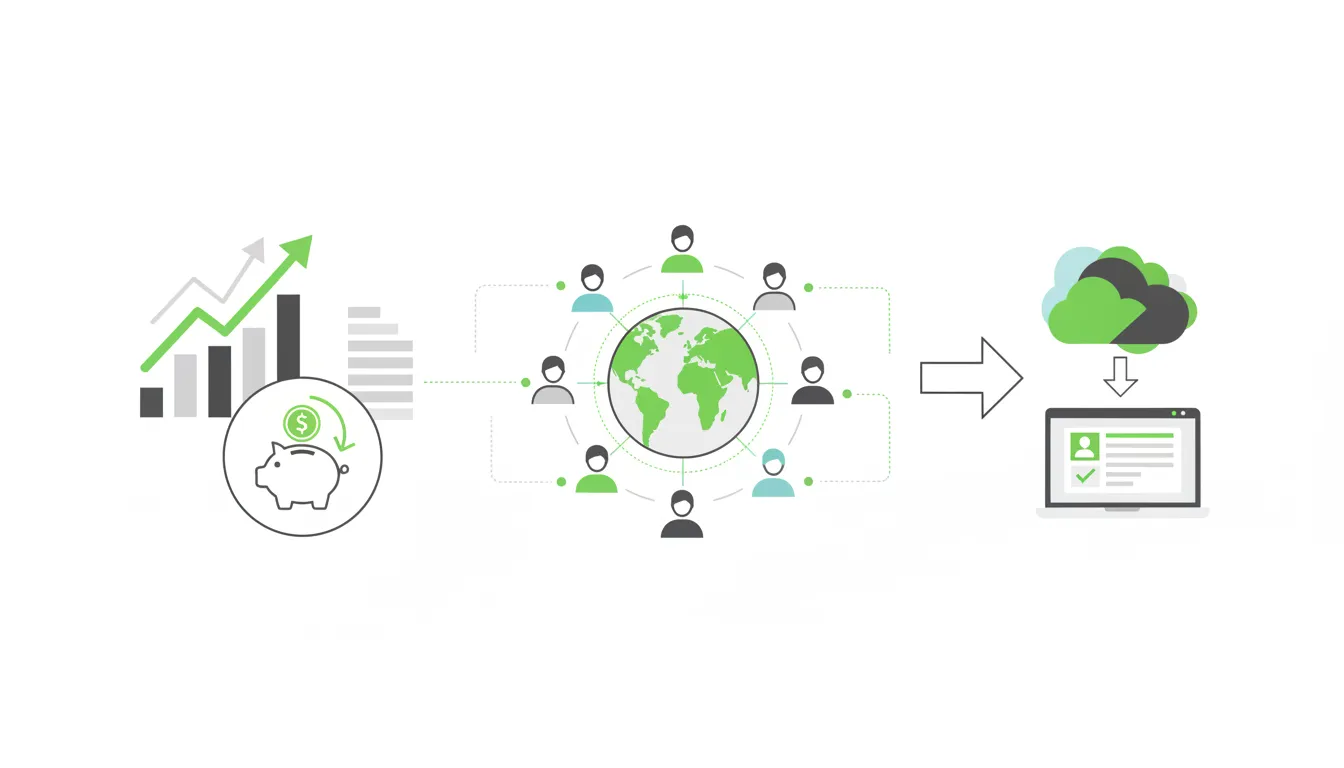
At Camfirst Solutions, we work with businesses every day that are constantly balancing growth ambitions against budget constraints. Hiring, training, infrastructure, and day-to-day operations consume resources that could otherwise fuel innovation and expansion. This is precisely where Business Process Outsourcing (BPO) enters the picture. Companies across industries are discovering that strategic outsourcing can cut operational costs by up to 40% — all while maintaining or even improving the quality of their output.
In this guide, we break down what BPO is, the different types available, how the cost savings actually work, and how to select the right outsourcing partner for your organization.
What Is Business Process Outsourcing?
Business Process Outsourcing refers to the practice of contracting specific business functions to a third-party service provider. Rather than handling every operational task internally, organizations delegate non-core processes — such as customer support, data entry, payroll, or marketing — to specialized firms that can execute them more efficiently.
BPO is not about cutting corners. It is about reallocating your most valuable resources toward activities that directly drive revenue, while trusted partners handle the rest. At Camfirst Solutions, we have seen firsthand how a well-structured outsourcing strategy transforms businesses from overextended operations into lean, competitive enterprises.
Types of BPO
Understanding the different categories of BPO helps you determine which functions are the best candidates for outsourcing.
Back-Office BPO
Back-office outsourcing covers internal business processes that do not directly involve customer interaction. Common examples include:
- Accounting and bookkeeping — processing invoices, managing ledgers, and preparing financial statements
- Human resources administration — payroll processing, benefits management, and compliance tracking
- Data entry and management — digitizing records, maintaining databases, and generating reports
- IT support and infrastructure management — server maintenance, software updates, and helpdesk support
These functions are essential but repetitive, making them ideal candidates for outsourcing to providers with established systems and trained personnel.
Front-Office BPO
Front-office outsourcing handles customer-facing activities. This includes:
- Customer service and support — phone, email, and live chat assistance
- Sales and lead generation — outbound calling, appointment setting, and pipeline management
- Technical support — troubleshooting, product guidance, and escalation management
Businesses that need to scale their customer-facing operations quickly often benefit from inbound and outbound service providers who maintain dedicated, trained teams ready to represent your brand.
Knowledge Process Outsourcing (KPO)
KPO involves outsourcing tasks that require specialized knowledge or analytical skills. Examples include market research, legal process support, financial analysis, and content creation. KPO providers bring domain expertise that may be difficult or expensive to develop in-house. If your business handles sensitive data, it is also worth reviewing your cybersecurity practices for small business before engaging any external partner.
Digital and Marketing BPO
A growing segment of outsourcing involves digital functions such as social media management, search engine optimization, pay-per-click advertising, and content marketing. Partnering with a digital marketing team allows businesses to execute sophisticated campaigns without building an entire marketing department from scratch.
The Cost Breakdown: Where the 40% Savings Come From
The claim that BPO saves up to 40% on operational costs is not speculative — it is grounded in measurable reductions across several cost categories.
Labor Costs
Labor is typically the largest line item in any operational budget. Outsourcing to regions with lower labor costs — or simply to providers who achieve economies of scale — can reduce staffing expenses by 30% to 50%. This includes not only salaries but also benefits, insurance, overtime, and employer taxes.
Recruitment and Training
Hiring a single employee involves advertising the position, screening candidates, conducting interviews, and onboarding. Industry estimates put the average cost-per-hire at several thousand dollars, with training costs on top. BPO providers absorb these expenses entirely, delivering trained personnel from day one.
Infrastructure and Technology
Maintaining office space, workstations, software licenses, and IT infrastructure represents a significant fixed cost. When you outsource a function, the provider supplies all necessary infrastructure. You convert a fixed cost into a variable one, paying only for the output you need.
Management Overhead
Every in-house team requires supervision, performance reviews, scheduling, and administrative coordination. Outsourcing transfers this management burden to the provider, freeing your leadership team to focus on strategic priorities rather than operational logistics.
Error Reduction and Rework
Specialized BPO providers have refined their processes over thousands of engagements. Their error rates are often lower than those of in-house teams handling the same tasks on a smaller scale. Fewer errors mean less time and money spent on corrections, refunds, and customer recovery.
Quality Improvements Through Specialization
One of the most persistent misconceptions about outsourcing is that lower cost automatically means lower quality. The opposite is frequently true. BPO providers succeed or fail based on the quality of their output, which means they invest heavily in training, quality assurance, and process optimization.
Dedicated Expertise
A BPO provider handling customer support for dozens of clients develops a depth of expertise that a single company’s internal team rarely matches. The same applies to outsourced content writing, where specialized writers produce higher-quality output faster than generalist in-house staff. They encounter a wider variety of scenarios, refine their scripts and processes continuously, and apply best practices learned across industries.
Quality Assurance Programs
Reputable providers implement structured QA programs that include call monitoring, performance scoring, regular audits, and continuous feedback loops. These programs ensure consistent service delivery and create a culture of accountability.
Technology and Tools
BPO firms invest in enterprise-grade tools — CRM platforms, workforce management software, analytics dashboards, and automation systems — that would be prohibitively expensive for most individual businesses to acquire and maintain. You gain access to these tools as part of the service.
Scalability: Growing Without Growing Pains
Scalability is one of the most compelling advantages of BPO. Businesses experience fluctuations in demand — seasonal peaks, product launches, market expansions — and scaling an in-house team up or down to match these fluctuations is slow and expensive.
With a BPO partner, you can:
- Scale up quickly by adding trained agents or processors within days, not months
- Scale down without layoffs when demand subsides, avoiding severance costs and morale damage
- Enter new markets by leveraging your provider’s multilingual and multi-regional capabilities
- Extend operating hours to offer 24/7 coverage without managing night shifts internally
This flexibility is especially valuable for growing businesses that need to respond to opportunities faster than their internal capacity allows. A dedicated virtual assistant service can provide the exact level of support you need at any given time, adjusting as your requirements evolve.
Risk Management and Business Continuity
Concentrating all operations in a single location or team creates vulnerability. A single disruption — a natural disaster, a key employee departure, a technology failure — can halt critical processes. BPO introduces geographic and organizational diversification that strengthens your resilience.
Operational Redundancy
Leading BPO providers maintain multiple delivery centers, backup systems, and disaster recovery protocols. If one site experiences an issue, operations shift seamlessly to another location with minimal or no downtime.
Compliance and Security
Established providers invest in compliance frameworks, data security certifications, and regulatory adherence that meet or exceed industry standards. For businesses in regulated industries, partnering with a compliant BPO provider can actually reduce compliance risk compared to managing everything internally. To keep your outreach channels performing, consider pairing outsourced operations with proven email marketing strategies that your BPO team can execute on your behalf.
Contractual Accountability
BPO relationships are governed by service level agreements (SLAs) that define performance standards, response times, and penalties for underperformance. This contractual structure creates a level of accountability that is difficult to enforce with internal teams.
How to Choose the Right BPO Partner
Selecting the wrong outsourcing partner can negate every potential benefit. Here is a structured approach to making the right choice.
Define Your Objectives Clearly
Before evaluating providers, document exactly which processes you want to outsource, what outcomes you expect, and how you will measure success. Vague objectives lead to vague results.
Evaluate Industry Experience
Look for providers with demonstrated experience in your industry. A partner who understands your market, regulatory environment, and customer expectations will deliver better results with a shorter ramp-up period.
Assess Technology and Infrastructure
Review the provider’s technology stack, security protocols, and business continuity plans. Their infrastructure should meet or exceed what you would build internally.
Check References and Track Records
Request client references and case studies. Speak directly with current or former clients about their experience, the challenges they encountered, and how the provider handled them.
Start with a Pilot Program
Rather than outsourcing an entire function at once, begin with a pilot engagement. This allows you to evaluate the provider’s performance, communication style, and cultural fit before committing to a larger scope.
Prioritize Communication and Transparency
The best BPO relationships are built on clear, frequent communication. Your provider should offer regular reporting, designated account managers, and a collaborative approach to problem-solving.
At Camfirst Solutions, we structure every engagement around transparency and measurable results, ensuring that our clients maintain full visibility into the work being performed on their behalf.
Industries That Benefit Most from BPO
While virtually any business can benefit from outsourcing, certain industries see particularly strong returns.
E-Commerce and Retail
Online retailers face high volumes of customer inquiries, order processing, and returns management. BPO allows them to handle peak seasons without permanently expanding their workforce. Combined with a strong digital marketing strategy, outsourced operations create a scalable foundation for rapid growth.
Healthcare
Medical practices and health organizations outsource billing, claims processing, appointment scheduling, and patient follow-up. This reduces administrative burden on clinical staff and improves the patient experience.
Financial Services
Banks, insurance companies, and fintech firms outsource data processing, compliance checks, customer onboarding, and account management. The combination of high transaction volumes and strict regulatory requirements makes BPO especially valuable.
Technology and SaaS
Software companies outsource technical support, customer success, and back-office functions to focus their internal teams on product development and engineering — the activities that drive competitive advantage.
Real Estate
Property management firms and real estate agencies outsource lead qualification, appointment scheduling, tenant communication, and document processing. This allows agents to focus on closing deals rather than administrative tasks.
Professional Services
Law firms, accounting practices, and consulting firms outsource research, document preparation, scheduling, and client communication. BPO enables these organizations to serve more clients without proportionally increasing overhead.
Getting Started with BPO
The transition to outsourcing does not have to be a dramatic overhaul. The most successful implementations follow a phased approach:
- Audit your current operations to identify functions that are repetitive, resource-intensive, or outside your core competency
- Quantify the costs of performing these functions internally, including hidden costs like management time and opportunity cost
- Research providers who specialize in the functions you want to outsource and have experience in your industry
- Start small with a clearly defined pilot project and measurable success criteria
- Evaluate and expand based on results, gradually increasing the scope of your outsourcing partnership
The businesses that gain the most from BPO are those that treat it not as a cost-cutting measure alone, but as a strategic capability that enhances their overall operation.
Conclusion
Business Process Outsourcing is one of the most effective levers available to companies seeking to reduce costs, improve quality, and scale efficiently. The 40% savings figure is achievable — and in many cases conservative — when outsourcing is implemented thoughtfully and managed well.
The key is choosing the right partner, defining clear expectations, and maintaining an active, collaborative relationship. Whether you need customer support, back-office processing, digital marketing, or specialized knowledge work, the right BPO provider becomes an extension of your team rather than a distant vendor.
Ready to Cut Operational Costs With Professional BPO Services?
Outsourcing does not have to be complicated. At Camfirst Solutions, our BPO services are designed to integrate seamlessly with your existing operations, delivering measurable cost savings from day one. Whether you need customer support, back-office processing, or digital marketing execution, we build a tailored outsourcing strategy that fits your business goals. Contact us today for a free consultation and discover how much your business can save.