Building a social media strategy used to mean defining your target audience, picking a few platforms, creating a content calendar, and hoping for the best. That approach still works at a basic level, but it leaves enormous potential on the table. AI-powered social media strategy takes the same foundational elements and supercharges them with data-driven insights, predictive modeling, automated execution, and continuous optimization that manual processes simply cannot match. At Camfirst Solutions, we guide businesses through this transformation, and this tutorial walks you through every step of creating an AI-powered social media strategy from the ground up.
Step 1: Define Your Strategic Objectives
Every effective strategy starts with clear objectives, and an AI-powered strategy is no different. What changes is your ability to set more precise and ambitious objectives because AI gives you the tools to achieve them.
Start by identifying your primary business goals for social media. Common objectives include brand awareness growth, lead generation, customer engagement and retention, website traffic, community building, and direct sales through social commerce. Most businesses have multiple objectives, but prioritizing them is essential because your AI configuration and tool selection will differ based on which goals take precedence.
For each objective, define specific, measurable targets. Instead of “increase brand awareness,” set a target like “achieve a 40 percent increase in average post reach and a 25 percent increase in brand mention volume within six months.” These specific targets give your AI tools concrete performance benchmarks to optimize toward.
Document your current baseline metrics for each objective. You cannot measure improvement without knowing where you started. Pull data from your existing social media analytics, Google Analytics, CRM, and any other relevant systems. This baseline data also serves as initial training data for your AI tools.
Step 2: Conduct AI-Assisted Audience Research
Traditional audience research relies on demographics, surveys, and general platform data. AI-assisted research goes deeper by analyzing behavioral patterns, content preferences, engagement triggers, and psychographic signals at a scale and granularity that manual research cannot achieve.
Analyzing Existing Audience Data
Feed your existing social media analytics data into your AI tools. Look for patterns in who engages with your content, when they engage, what content types drive the most interaction, and what topics generate the most conversation. AI can identify audience micro-segments that traditional analysis overlooks — such as a small but highly engaged group of followers who consistently share your content with their networks, amplifying your organic reach.
Competitive Audience Analysis
Use AI social listening tools to analyze your competitors’ audiences. Identify which audience segments engage most with competitor content, what content gaps exist in your competitive landscape, and where competitor audiences express unmet needs or frustrations that your brand could address.
Building AI-Enhanced Audience Personas
Combine your first-party audience data with AI-generated insights to create detailed audience personas. These personas should go beyond basic demographics to include content consumption patterns, preferred social platforms and features, peak engagement times by platform, content format preferences, emotional triggers and values, and purchase consideration factors.
These enhanced personas become the foundation for AI-driven content targeting and personalization throughout your strategy.
Step 3: Select Your Platform and Tool Stack
With clear objectives and detailed audience insights, you can make informed decisions about which platforms to prioritize and which AI tools to deploy.
Platform Selection
Your audience research will reveal where your target segments spend their time and how they use each platform. Rather than spreading resources thin across every platform, focus on the two to four platforms where your audience is most active and where the platform’s native features align with your content strengths and business objectives.
Consider how AI capabilities vary by platform. Some platforms offer more robust API access for AI tool integration, better data export for analytics, or native AI features that complement your third-party tools. LinkedIn’s AI-powered content suggestions, Instagram’s algorithmic insights, and YouTube’s AI-driven content optimization tools are all worth factoring into your platform decisions.
Tool Selection and Integration
Select AI tools that address your specific strategic needs. For most businesses, this means a primary social media management platform with AI capabilities, supplemented by specialized tools for content generation, analytics, or social listening as needed. Our AI social media management services can help you evaluate and implement the right tool stack for your objectives.
Ensure your selected tools integrate with each other and with your broader marketing technology stack. Data silos are the enemy of AI-powered strategy — the more connected your data sources, the smarter your AI becomes.
Step 4: Develop Your AI-Powered Content Strategy
Content is the execution layer of your social media strategy, and AI transforms how you plan, create, distribute, and optimize it.
Content Pillar Development
Define three to five content pillars that align with your brand expertise, audience interests, and business objectives. These pillars provide thematic structure for your content while leaving room for AI-driven optimization within each category.
For example, a digital marketing agency might define pillars like industry trends and insights, tactical how-to content, client success stories, company culture and values, and thought leadership on emerging technologies. AI tools can then analyze which pillar generates the most engagement, leads, or conversions and adjust content distribution accordingly.
AI Content Creation Workflows
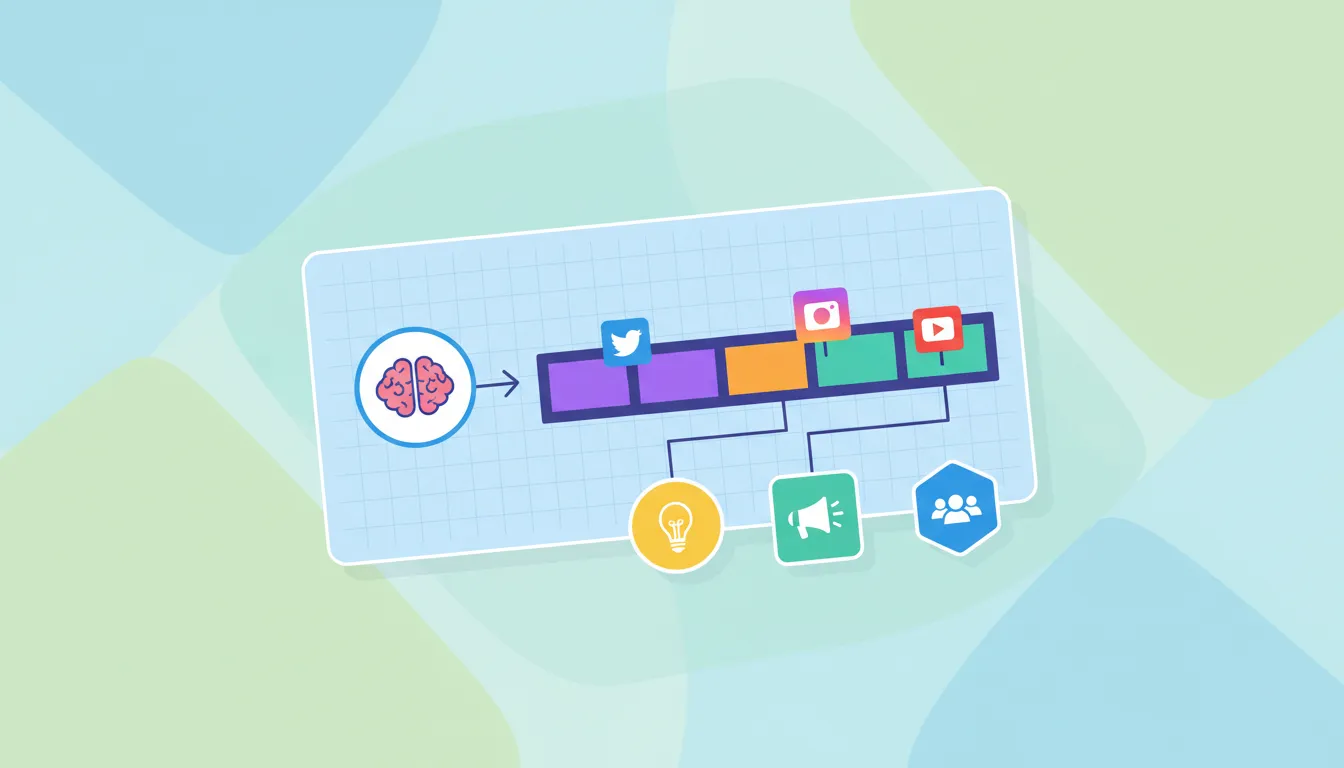
Establish clear workflows for how AI assists in content creation. A typical workflow might look like this:
- Ideation — AI analyzes trending topics, audience questions, competitor gaps, and seasonal opportunities to suggest content ideas aligned with your pillars.
- Draft generation — AI creates initial drafts for captions, posts, and content adaptations based on your brand voice training and performance data.
- Human review and refinement — A team member reviews AI drafts, adds personal insight, checks brand alignment, and approves or revises the content.
- Visual creation — AI tools generate or suggest visual assets, with design review for brand consistency.
- Scheduling — AI determines optimal publishing times based on audience activity data and content saturation analysis.
Our AI content generation services are designed to integrate seamlessly into this type of workflow, handling the heavy lifting of content production while maintaining the human oversight that ensures quality and authenticity.
Content Calendar with AI Optimization
Build your content calendar with flexibility for AI-driven adjustments. Rather than rigidly planning every post weeks in advance, create a framework where core content is planned but specific timing, format variations, and reactive content opportunities are informed by real-time AI analysis.
For guidance on building effective content calendars that incorporate AI insights, see our tutorial on how to create a content calendar. The principles of consistent scheduling and thematic planning apply equally to AI-powered strategies — the difference is that AI helps you optimize within that structure.
Step 5: Implement AI-Driven Engagement Protocols
Engagement is where many social media strategies fall short. Creating great content means little if you do not actively engage with your audience. AI transforms engagement from a reactive, time-consuming task into a proactive, efficient system.
Automated Response Framework
Configure AI-powered response tools to handle routine interactions. Categories to automate include acknowledgment of positive comments and compliments, answers to frequently asked questions about products, services, or hours, routing of customer service inquiries to appropriate channels, and initial responses to direct messages during off-hours.
For each category, create response templates that the AI can personalize based on context. Train the AI on your brand voice to ensure automated responses feel authentic and consistent with your human communication style.
Escalation Protocols
Define clear triggers for when AI should escalate an interaction to a human team member. These triggers should include negative sentiment detection, complex questions that require specialized knowledge, interactions with high-value customers or prospects, any mention of legal or compliance-sensitive topics, and conversations that shift from routine to emotional.
Proactive Engagement Strategy
AI can identify engagement opportunities that humans typically miss. Configure your tools to alert you when industry influencers discuss topics relevant to your brand, when potential customers ask questions your business can answer, when competitors experience negative sentiment that creates openings, and when community discussions align with your content pillars.
Step 6: Build Your Analytics and Optimization Framework
An AI-powered strategy is only as good as its ability to learn and improve over time. Your analytics framework is what enables this continuous optimization.
Define Key Performance Indicators
For each strategic objective, define the specific KPIs that measure progress. Go beyond surface metrics to focus on indicators that connect to business outcomes:
- Brand awareness: Reach, impressions, share of voice, brand mention volume and sentiment
- Engagement: Engagement rate by content type and platform, comment quality score, share rate
- Lead generation: Click-through rate to landing pages, social-originated leads, cost per social lead
- Website traffic: Social referral traffic, pages per session from social, bounce rate from social
- Revenue: Social-attributed conversions, revenue per social channel, customer acquisition cost from social
AI-Powered Reporting
Configure your AI tools to generate automated performance reports at weekly and monthly intervals. These reports should not just present data — they should include AI-generated insights about what is working, what is declining, and what actions to take.
The most valuable AI analytics features include anomaly detection that flags unexpected performance changes, trend identification that spots emerging patterns before they become obvious, predictive modeling that forecasts future performance based on current trajectories, and recommendation engines that suggest specific optimizations to test.
Optimization Cycles
Establish regular optimization cycles where you review AI insights and make strategic adjustments. A typical cadence includes weekly tactical adjustments to content mix, posting times, and engagement approaches based on recent performance data, monthly strategic reviews of overall progress toward objectives and adjustments to AI configurations and content pillars, and quarterly strategic reassessments of audience personas, platform priorities, and tool effectiveness.
Step 7: Integrate Social Media with Your Broader Digital Strategy
Your AI-powered social media strategy should not operate in isolation. Connect it to your broader digital marketing efforts for maximum impact.
Cross-Channel Data Sharing
Ensure that insights from your social media AI tools flow into other marketing functions. Social media engagement data can inform email segmentation, content marketing topic selection, paid advertising targeting, and product development priorities. Similarly, data from your email campaigns, website analytics, and sales CRM should feed back into your social media AI to improve its understanding of your audience and business context.
Unified Customer Journey Mapping
Use AI to map how social media touchpoints fit into the broader customer journey. Understanding where social media interactions occur in the path from awareness to purchase allows you to create content specifically designed for each stage of the funnel. AI can identify which social media interactions are most correlated with eventual conversion, helping you prioritize the types of engagement that drive revenue.
Paid and Organic Integration
Your organic social media data is a goldmine for paid advertising optimization. Use AI to identify which organic content themes, formats, and messaging angles generate the strongest engagement, then amplify those winning elements through paid campaigns. For a comprehensive understanding of how AI transforms social media management holistically, including paid integration, explore our complete guide to AI social media management.
Step 8: Plan for Scale and Evolution
An effective AI-powered social media strategy is designed to scale and evolve. As your AI tools accumulate more data, their recommendations become more accurate and valuable. Plan for this growth trajectory.
Scaling Content Production
As your AI tools become better calibrated to your brand voice and audience preferences, you can gradually increase content volume without proportionally increasing team size. Plan for phased increases in posting frequency and platform expansion as your AI workflows mature.
Adopting New AI Capabilities
The AI landscape evolves rapidly. Build flexibility into your strategy to incorporate new capabilities as they emerge. AI-generated video content, real-time content personalization, and predictive audience modeling are all areas where rapid advancement is expected. Stay informed about new developments and be ready to test promising capabilities within your existing framework.
Team Development
As AI handles more routine tasks, your team’s role shifts toward strategic oversight, creative direction, and relationship building. Invest in training that helps team members develop these higher-value skills alongside their AI tool proficiency.
Measuring the Success of Your AI-Powered Strategy
After implementing your strategy, benchmark your performance against the baselines you established in Step 1. Typical results for well-implemented AI-powered social media strategies include a 30 to 50 percent reduction in time spent on content creation and scheduling, a 20 to 40 percent improvement in engagement rates within the first quarter, a 15 to 30 percent increase in social-originated website traffic, and measurable improvements in lead quality and conversion rates from social channels.
Track these metrics consistently and use them to demonstrate ROI to stakeholders and justify continued investment in AI tools and capabilities.
Start Building Your AI-Powered Social Media Strategy
The shift to AI-powered social media strategy is not about replacing human creativity and judgment — it is about amplifying them with data, automation, and intelligence that makes every aspect of your social media operation more effective and efficient.
The eight steps outlined in this tutorial provide a comprehensive framework for building a strategy that leverages AI at every stage, from audience research through content creation to performance optimization. The key is to start with clear objectives, implement systematically, maintain human oversight, and commit to continuous learning and optimization.
Camfirst Solutions has helped businesses across industries build and execute AI-powered social media strategies that deliver measurable business results. Our team combines deep social media expertise with technical AI knowledge to create strategies that are both strategically sound and technically optimized.
Ready to build an AI-powered social media strategy that drives real business growth? Get in touch with our team to start planning your strategy today.