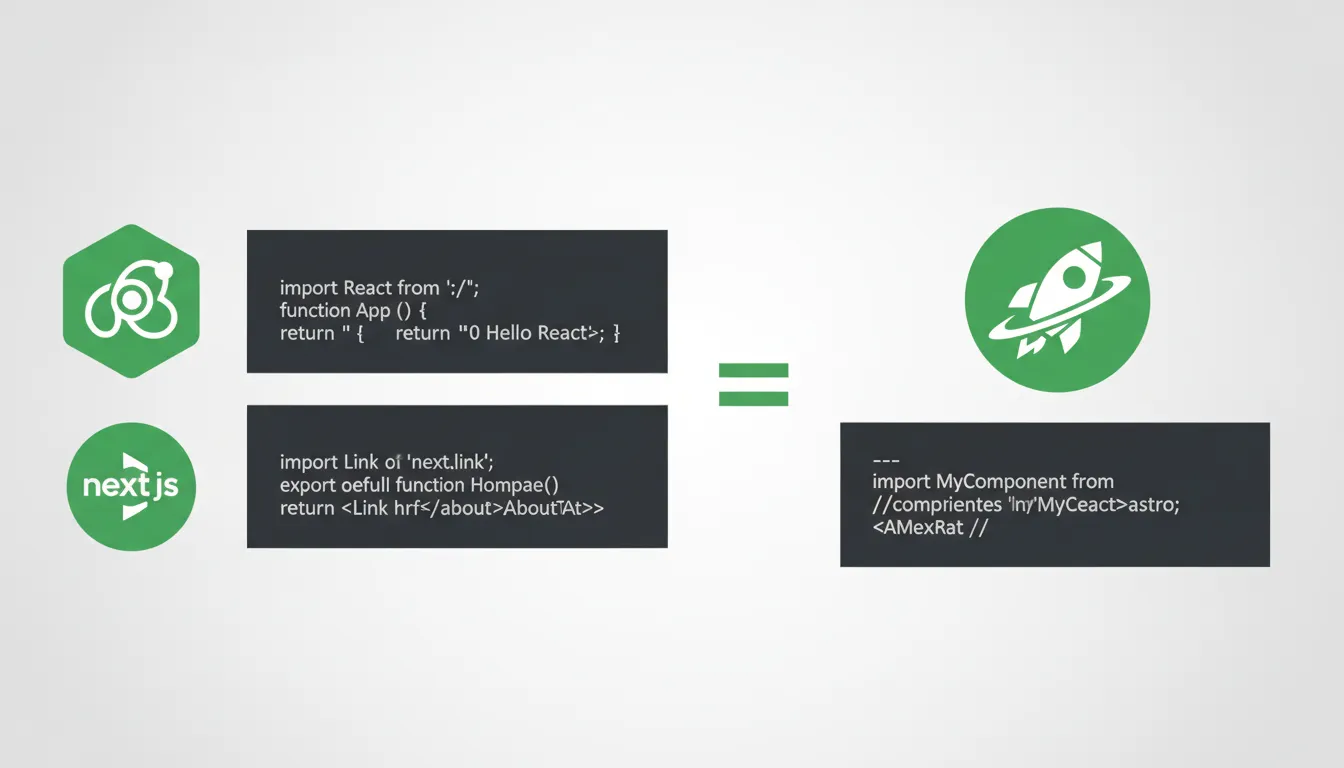
At Camfirst Solutions, we build with all three of these technologies daily. React, Next.js, and Astro represent three distinct approaches to building modern websites and web applications. React gives you a flexible UI library with full control over your architecture. Next.js builds on React with opinionated conventions, server-side rendering, and full-stack capabilities. Astro takes an entirely different path, prioritizing content delivery and shipping minimal JavaScript by default.
Each framework excels in different scenarios. For a broader look at the available options, see our overview of the best web development frameworks in 2026. Choosing between them requires understanding not just their features, but their underlying philosophies and the trade-offs each one makes. This guide breaks down the architectural differences, rendering strategies, performance characteristics, SEO capabilities, and developer experience of all three to help you make an informed decision.
Architecture and Philosophy
The architectural differences between these three technologies are fundamental, and understanding them is essential before evaluating any other criteria.
React: The Flexible UI Library
React is a library for building user interfaces through composable components. It does not include routing, server-side rendering, or a build system — those are concerns you address through additional libraries and tools. React’s core job is to efficiently render and update UI based on state changes using a virtual DOM.
This minimal approach gives you maximum control. You decide how to handle routing (React Router, TanStack Router), state management (Redux, Zustand, Jotai), data fetching (TanStack Query, SWR), and styling (CSS Modules, Tailwind, styled-components). The result is a highly customized architecture tailored to your exact needs, but it also means more decisions upfront and more integration work.
Next.js: The Opinionated React Framework
Next.js wraps React in a comprehensive framework that makes most architectural decisions for you. File-based routing, built-in server-side rendering, API routes, middleware, image optimization, and font handling are all included. The App Router, which uses React Server Components by default, further blurs the line between frontend and backend.
Next.js adopts a convention-over-configuration philosophy. Place a file in the right directory with the right name, and Next.js handles the rest. This reduces boilerplate and ensures consistent patterns across projects, but it also means learning and adhering to Next.js-specific conventions.
Astro: The Content-First Framework
Astro was designed from the ground up for content-driven websites. Its defining feature is the islands architecture: pages are rendered as static HTML by default, and interactive components (islands) are hydrated individually only when they need to be interactive. By default, Astro ships zero JavaScript to the browser.
Astro is also framework-agnostic. You can use React, Vue, Svelte, Solid, or Preact components within an Astro project. This makes Astro unique — it is not tied to any single UI library. Astro components themselves use a template syntax that closely resembles HTML with a frontmatter script block.
Rendering Strategies
How each framework renders content has profound implications for performance, SEO, and user experience.
Client-Side Rendering (CSR)
With CSR, the browser downloads a minimal HTML shell and a JavaScript bundle, which then renders the page content. React uses this approach by default when set up with tools like Vite or Create React App.
Advantages: Simple deployment (static files), rich interactivity, smooth page transitions.
Disadvantages: Slow initial page load, blank screen while JavaScript loads and executes, poor SEO for content that is not pre-rendered, higher Largest Contentful Paint (LCP) times.
Server-Side Rendering (SSR)
With SSR, the server generates the full HTML for each request and sends it to the browser. The page is visible immediately, and JavaScript hydrates it to add interactivity.
Next.js provides SSR through its App Router (Server Components render on the server by default) and through the getServerSideProps pattern in the Pages Router. SSR in Next.js is deeply integrated and requires minimal configuration.
React can implement SSR, but it requires manual setup with tools like Express and ReactDOMServer, or using a framework like Next.js or Remix.
Astro supports SSR as an opt-in feature through server adapters for platforms like Node.js, Vercel, Netlify, and Cloudflare.
Static Site Generation (SSG)
With SSG, pages are pre-rendered at build time and served as static HTML files. This provides the fastest possible Time to First Byte (TTFB) because no server processing occurs at request time.
Astro uses SSG by default. Every page is pre-rendered to static HTML at build time unless you explicitly opt into server-side rendering.
Next.js supports SSG through generateStaticParams in the App Router and getStaticProps in the Pages Router. You can mix SSG and SSR pages within the same Next.js project.
React alone does not provide SSG. You need a framework like Next.js, Gatsby, or a custom build pipeline.
Islands Architecture
The islands architecture, used by Astro, treats each interactive component as an isolated island in a sea of static HTML. Each island is hydrated independently, meaning a complex interactive widget in the sidebar does not delay the hydration of a simple interactive element in the header.
Astro provides client directives to control when islands hydrate:
client:load— hydrate immediately when the page loadsclient:idle— hydrate when the browser is idleclient:visible— hydrate when the component enters the viewportclient:media— hydrate when a media query matches
This granular control over hydration is something neither React nor Next.js offers natively. It results in significantly less JavaScript being sent to and executed in the browser, which directly improves your website speed score.
Performance Comparison
Performance is where the differences between these frameworks become most tangible.
JavaScript Bundle Size
The amount of JavaScript shipped to the browser directly impacts page load speed, Time to Interactive, and Core Web Vitals scores.
- Astro: Ships zero JavaScript by default. Only interactive islands include JavaScript, and each island’s JS is loaded independently. A typical content page might ship 0-20 KB of JavaScript.
- Next.js: Ships the React runtime plus Next.js framework code, even for largely static pages. A minimal Next.js page typically ships 80-100+ KB of JavaScript (compressed). Server Components have reduced this compared to earlier versions, but a significant baseline remains.
- React (CSR): Ships the React runtime plus your application code. A simple app often starts at 50-80 KB (compressed) before any application logic, and grows from there.
Core Web Vitals
Core Web Vitals are the performance metrics Google uses as ranking signals: Largest Contentful Paint (LCP), Interaction to Next Paint (INP), and Cumulative Layout Shift (CLS).
Astro consistently achieves the best Core Web Vitals scores. With minimal JavaScript and pre-rendered HTML, LCP is fast, INP is excellent (less JavaScript means fewer long tasks), and CLS is minimal when images and layouts are handled correctly. These performance advantages translate directly into better SEO rankings.
Next.js achieves good Core Web Vitals with proper optimization. Built-in image optimization, font optimization, and automatic code splitting help, but the React hydration step can impact INP on complex pages.
React (CSR) typically has the most challenging Core Web Vitals profile. The blank screen during initial JavaScript loading hurts LCP, and heavy JavaScript execution can impact INP.
Build Performance
- Astro builds are typically fast because it generates static HTML with minimal JavaScript processing.
- Next.js builds can be slower for large sites, especially when using SSG for thousands of pages. Incremental Static Regeneration helps by allowing pages to be rebuilt individually.
- React build times depend entirely on your bundler configuration and project size.
SEO Capabilities
For any project where organic search traffic matters, SEO capabilities are a critical evaluation criterion.
Astro
Astro is inherently SEO-friendly. Every page is pre-rendered as complete HTML, meaning search engine crawlers receive fully formed content without needing to execute JavaScript. Astro also makes it straightforward to manage meta tags, generate sitemaps, and implement structured data. The performance benefits — fast load times and excellent Core Web Vitals — provide additional SEO advantages.
Next.js
Next.js provides strong SEO capabilities through its Metadata API, which allows you to define meta tags, Open Graph data, and structured data at the page level. Server-rendered and statically generated pages are fully crawlable. The next/image component helps with image optimization, which impacts Core Web Vitals. Next.js also supports dynamic metadata generation, which is useful for pages with content from a CMS or database.
React (CSR)
Client-side rendered React applications face significant SEO challenges. While Google can render JavaScript, it does so on a second pass with a delay, and other search engines may not render JavaScript at all. Critical content that depends on JavaScript execution may not be indexed promptly or completely. For SEO-sensitive projects, standalone React with CSR is generally not recommended.
Developer Experience
Developer experience impacts productivity, hiring, and long-term maintenance.
React
React has the most mature ecosystem and the largest community. Finding answers to questions, hiring developers, and sourcing third-party components is straightforward. However, the need to assemble your own stack from multiple libraries can lead to decision fatigue and inconsistency.
React’s JSX syntax is well-established, and the hooks API provides a clean pattern for managing state and side effects. TypeScript support is excellent. Developer tooling, including React DevTools and extensive IDE support, is the most comprehensive of any framework.
Next.js
Next.js reduces the decision-making burden by providing an integrated solution. The development server supports hot module replacement, and the framework provides helpful error overlays. The file-based routing system is intuitive once you learn the conventions.
However, Next.js adds complexity on top of React. Understanding the distinction between Server Components and Client Components, knowing when to use each rendering strategy, and navigating the caching behavior requires study. The framework has a larger API surface to learn, but the payoff is a more productive workflow once mastered.
Astro
Astro offers a refreshingly simple developer experience for content-focused projects. Components are essentially HTML with a script block, making them immediately familiar. Content collections provide type-safe handling of Markdown and MDX files. The ability to use components from React, Vue, or Svelte within the same project provides unusual flexibility.
The development server is fast, and the build process is straightforward. The learning curve is gentler than Next.js, though developers accustomed to building highly interactive SPAs may find the content-first model requires a shift in thinking. As AI continues to change web development, all three frameworks are evolving to incorporate new capabilities.
Ecosystem and Community
React
React has the largest ecosystem of any frontend technology. NPM hosts tens of thousands of React-specific packages, and virtually every third-party service provides a React integration. The community produces extensive tutorials, courses, and open-source projects.
Next.js
Next.js benefits from React’s ecosystem while adding its own layer of tools, templates, and integrations. Vercel’s marketplace offers pre-built templates, and the framework has strong integration with headless CMS platforms, databases, and deployment services. The Next.js community is large and active.
Astro
Astro’s ecosystem is smaller but growing steadily. The Astro integration catalog includes adapters for major deployment platforms, CMS integrations, and UI framework adapters. The community is engaged and welcoming, though you will find fewer pre-built solutions compared to React or Next.js.
When to Use Each Framework
Choose React When:
- You are building a highly interactive application like a dashboard, admin panel, or complex SPA
- Your team has deep React expertise and established patterns
- You need to embed interactive components into an existing application
- You want maximum control over every architectural decision
- SEO is not a primary concern for the project
Choose Next.js When:
- You need server-side rendering or static generation with React
- SEO is important and your site has significant content
- You want full-stack capabilities without managing a separate backend
- You are building an e-commerce site, marketing site, or SaaS product
- You want an opinionated framework that reduces architectural decisions
Choose Astro When:
- You are building a content-heavy website such as a blog, documentation site, or marketing site
- Page load performance is a top priority
- You want the best possible Core Web Vitals scores
- Your site is primarily static with limited interactive elements
- Your team includes developers familiar with different UI frameworks
Can You Combine Them?
Yes, and this is one of the most powerful aspects of the modern web ecosystem.
Astro with React components: You can use React components as interactive islands within an Astro site. This gives you Astro’s performance for the overall site with React’s interactivity where you need it.
React within a Next.js project: Next.js is built on React, so every React component works within Next.js. You get the full React ecosystem with Next.js conventions and optimizations layered on top.
Micro-frontends: For large organizations, it is possible to use different frameworks for different parts of an application, though this adds complexity and is typically only justified at significant scale.
Making Your Decision
The choice between React, Next.js, and Astro is ultimately a choice about priorities.
If interactivity and flexibility are your top priorities, React gives you the most control. If you want the power of React with built-in server rendering, routing, and optimizations, Next.js is the clear path. If performance and content delivery matter most, Astro delivers results that are difficult to match.
At Camfirst Solutions, we build with all three technologies and recommend the right tool based on each project’s specific requirements. Whether you need a high-performance content site, a dynamic web application, or a custom software solution that combines multiple technologies, our team pairs expert development with thoughtful UI/UX design to deliver results that perform.
Get a Framework Recommendation for Your Project
Choosing the wrong framework costs time and money. Our development team evaluates your goals, audience, and technical requirements to recommend the best approach — and then builds it to the highest standard. Contact us today to discuss your project and receive a personalized framework recommendation.