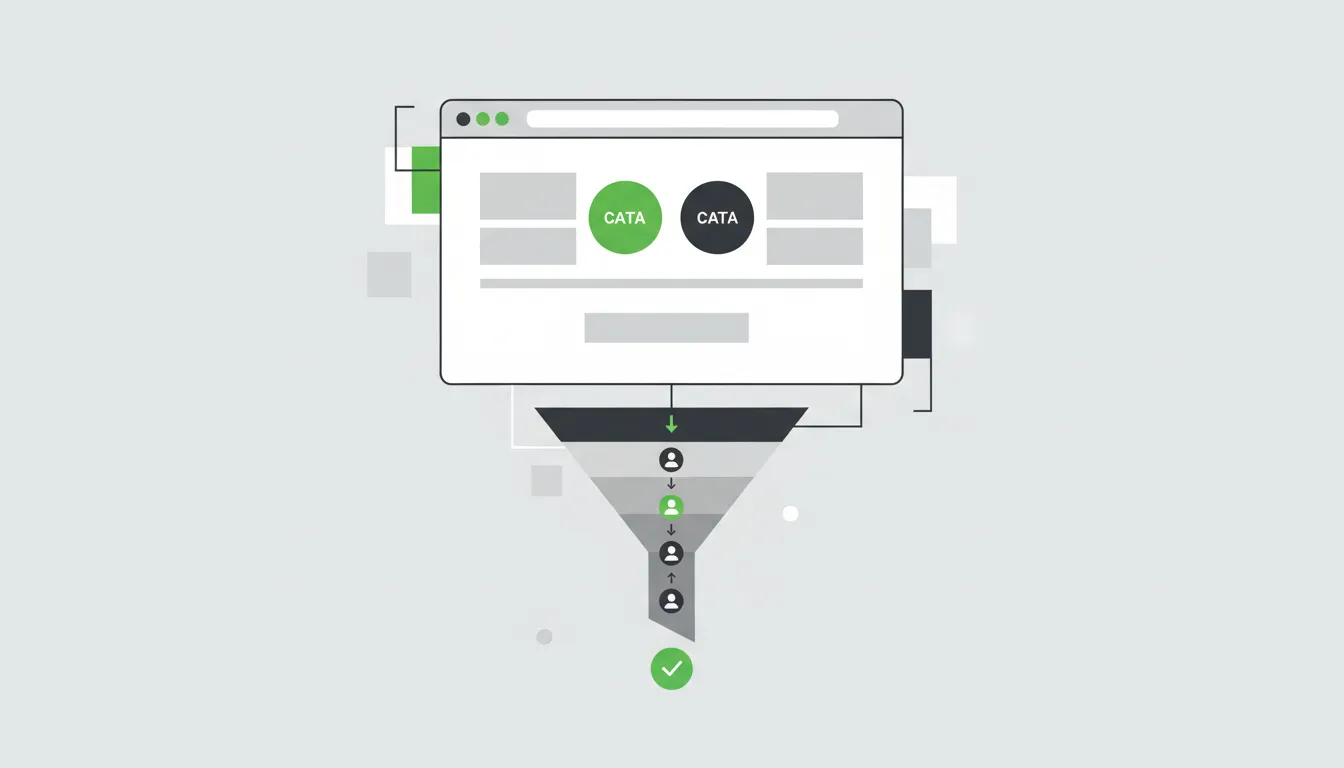
At Camfirst Solutions, we build landing pages engineered for a single purpose. A landing page has one job: turn a visitor into a lead or customer. Unlike a homepage that serves multiple audiences and purposes, a landing page is built around a single offer, a single message, and a single desired action. When done well, landing pages consistently outperform general website pages in conversion rate. When done poorly, they waste the advertising budget that brought visitors there in the first place.
This guide covers the practical elements of high-converting landing pages, from the headline at the top to the analytics tracking that tells you whether it is working.
Start With a Clear Goal
Before you design anything, define exactly what you want the visitor to do. Common landing page goals include:
- Filling out a contact form
- Signing up for a free trial or demo
- Downloading a resource (ebook, checklist, whitepaper)
- Making a purchase
- Booking a consultation call
Every element on the page should support that single goal. If a section, image, or link does not move the visitor closer to taking action, remove it. Landing pages convert because they eliminate distractions, not because they add more content.
Headline Formulas That Capture Attention
Your headline is the first thing visitors read, and for many of them, it is the last. Research consistently shows that roughly 80 percent of visitors read the headline, but only 20 percent read the rest of the page. A weak headline means the rest of your carefully crafted page goes unseen.
Proven Headline Structures
- Outcome-focused: “Get [Desired Result] Without [Common Pain Point].” Example: “Get More Qualified Leads Without Increasing Your Ad Spend.”
- How-to: “How to [Achieve Goal] in [Timeframe].” Example: “How to Double Your Email List in 90 Days.”
- Question-based: “Still [Struggling With Problem]?” Example: “Still Losing Customers to Slow Page Load Times?”
- Proof-driven: “[Number] [Audience] Have Already [Achieved Result].” Example: “2,500 Small Businesses Have Already Switched to Smarter Marketing.”
Headline Best Practices
- Keep it under 12 words when possible.
- Lead with the benefit, not the feature.
- Match the headline to the ad or link that brought the visitor to the page. If your Google Ad says “Free SEO Audit,” the landing page headline should reinforce that exact promise.
- Use a subheadline to add supporting detail or address a secondary concern.
Designing an Effective Hero Section
The hero section is the area visible without scrolling, sometimes called “above the fold.” It sets the tone for the entire page and must communicate your value proposition within seconds.
Key Elements of a Strong Hero Section
- Headline and subheadline positioned prominently, typically on the left or center of the page.
- A relevant image or short video that supports the message. Avoid generic stock photos. Use images that show your product in action, a real customer outcome, or a visual representation of the result you are promising.
- A primary call-to-action button that is immediately visible. The visitor should not have to scroll or search to find it.
- A brief supporting statement (one to two sentences) that clarifies what the visitor will get and why it matters.
The hero section should answer three questions within five seconds: What is this? What is in it for me? What should I do next?
Our UI/UX design team specializes in building hero sections and page layouts that guide the visitor’s eye naturally toward the action you want them to take.
Social Proof Placement
Social proof is one of the most powerful conversion drivers on any landing page. It reduces the perceived risk of taking action by showing visitors that other people have already done so and had a positive experience.
Types of Social Proof
- Customer testimonials: Direct quotes from satisfied clients, ideally with their name, company, and photo.
- Case study results: Specific, measurable outcomes. “Increased organic traffic by 180% in six months” is far more persuasive than “Great service.”
- Client logos: Displaying the logos of well-known companies you have worked with builds instant credibility.
- Review scores and counts: “Rated 4.9 out of 5 from 320 reviews” gives visitors a quantified reason to trust you.
- Trust badges: Industry certifications, security seals, partner badges (Google Partner, Shopify Partner, etc.).
Where to Place Social Proof
- Directly below the hero section to reinforce the value proposition before the visitor scrolls further.
- Adjacent to the form or CTA to reduce hesitation at the moment of decision.
- Throughout the page between content sections to maintain confidence as the visitor reads.
The most effective landing pages weave social proof into the natural flow of the page rather than isolating it in a single section.
CTA Optimization
The call-to-action button is where conversions happen. Every design and copy decision on the page leads to this moment, so the CTA deserves careful attention.
Button Copy
Generic button text like “Submit” or “Click Here” tells the visitor nothing about what they will get. Use action-oriented, benefit-driven text instead:
- “Get My Free Quote” instead of “Submit”
- “Start My Free Trial” instead of “Sign Up”
- “Download the Checklist” instead of “Click Here”
- “Book My Consultation” instead of “Contact Us”
First-person phrasing (“Get My…” rather than “Get Your…”) has been shown to increase click-through rates in multiple A/B tests, though results vary by audience.
Button Design
- Use a contrasting color that stands out from the rest of the page. The button should be the most visually prominent element in its section.
- Make the button large enough to tap easily on mobile devices (at least 44 by 44 pixels as recommended by accessibility guidelines).
- Add whitespace around the button so it does not feel crowded.
- Consider adding a brief line of microcopy below the button to address a common objection, such as “No credit card required” or “Cancel anytime.”
CTA Placement
Place your primary CTA in the hero section, then repeat it after each major content section. Long landing pages should include the CTA at least three times. Visitors should never have to scroll far to find the next opportunity to take action.
Form Design
If your landing page includes a form, its design directly impacts your conversion rate. Every additional field you add creates friction and reduces the number of people who complete it.
Form Best Practices
- Ask only for what you need. For a top-of-funnel offer like a free guide, name and email are usually sufficient. For a high-value request like a custom quote, asking for company name, phone number, and a brief description of the project is reasonable.
- Use single-column layouts. Research from the Baymard Institute confirms that single-column forms are completed faster and with fewer errors than multi-column layouts.
- Label fields clearly. Place labels above the input fields, not inside them as placeholder text that disappears when the user starts typing.
- Use smart defaults and dropdowns where possible to reduce typing, especially on mobile.
- Show a clear privacy statement near the form. Something as simple as “We will never share your information” can measurably improve form completion rates.
Multi-Step Forms
For pages that require more information, consider breaking the form into multiple steps. A multi-step form that starts with one easy question (like “What type of service are you looking for?”) and progressively asks for more details tends to convert better than a single long form. The psychological principle of commitment and consistency means that once someone starts filling out a form, they are more likely to finish it.
A/B Testing Your Landing Page
No landing page is perfect on the first attempt. A/B testing lets you compare two versions of a page element to see which one performs better, taking the guesswork out of optimization.
What to Test
- Headlines: Test different angles, lengths, and value propositions.
- Hero images: Compare product images vs. lifestyle images vs. no image.
- CTA button text and color: Even small changes can move the needle.
- Form length: Test a short form vs. a longer form to find the right balance between lead quality and volume.
- Social proof placement: Test testimonials near the hero vs. near the CTA.
- Page length: Test a concise page vs. a longer, more detailed version.
Testing Rules
- Test one variable at a time so you can attribute any change in performance to the specific element you modified.
- Run each test until you reach statistical significance. For most landing pages, this means at least 100 conversions per variation, though higher traffic pages can reach significance faster.
- Document your results. Over time, your testing history becomes a valuable playbook that informs future landing page builds.
Tools like Google Optimize (now integrated into GA4), VWO, and Optimizely make it straightforward to run A/B tests without developer involvement.
Mobile Optimization
More than half of web traffic now comes from mobile devices, and for many paid campaigns, the mobile share is even higher. A landing page that looks great on desktop but is difficult to use on a phone will lose conversions.
Mobile-Specific Considerations
- Simplify the layout. Mobile screens have limited space, so prioritize the headline, a brief value statement, and the CTA above the fold.
- Use larger fonts. Body text should be at least 16 pixels to avoid triggering zoom on mobile browsers.
- Make buttons full-width on mobile so they are easy to tap.
- Reduce image sizes and use modern formats like WebP to keep load times fast on cellular connections.
- Test on real devices. Browser emulators are helpful, but testing on actual phones reveals usability issues that emulators miss.
If you are running Google Ads campaigns or Facebook ad campaigns, keep in mind that Google’s Quality Score factors in landing page experience, including mobile usability. A poorly optimized mobile landing page can increase your cost per click and reduce your ad placement.
Page Speed
Page speed is a conversion factor and a ranking factor. Research from Google shows that as page load time increases from one second to three seconds, the probability of a visitor bouncing increases by 32 percent. At five seconds, it increases by 90 percent.
Speed Optimization Tactics
- Compress all images before uploading. Use tools like TinyPNG, Squoosh, or your build system’s image optimization pipeline.
- Minimize the number of HTTP requests by combining CSS and JavaScript files where practical.
- Use lazy loading for images and videos that appear below the fold.
- Choose a reliable hosting provider with fast server response times.
- Implement browser caching so returning visitors experience faster load times.
- Remove any third-party scripts that are not essential to the page’s function.
Our web development team builds landing pages with performance as a core requirement, ensuring fast load times across all devices and connection speeds.
Trust Signals
Beyond social proof, there are additional trust signals that can influence a visitor’s willingness to convert.
- Professional design: A page that looks outdated or poorly designed signals a lack of credibility, regardless of how good the offer is. Investing in quality UI/UX design pays for itself through higher conversion rates.
- Contact information: Display a phone number, email address, or physical address. Knowing they can reach a real person makes visitors more comfortable sharing their information.
- Money-back guarantees or risk-free offers: If applicable, state your guarantee clearly near the CTA.
- SSL certificate: Make sure your page loads over HTTPS. Modern browsers flag non-secure pages, which immediately undermines trust.
- Privacy policy link: Especially important for pages that collect personal data.
Analytics Tracking
A landing page without proper analytics tracking is a missed opportunity. You need to know not just how many visitors arrive, but how they behave on the page and where they drop off.
Essential Tracking Setup
- Install Google Analytics 4 with your form submission or purchase event marked as a key event (conversion). This lets you measure your true conversion rate and attribute it to specific traffic sources. For a step-by-step walkthrough, see our guide on how to track Google Ads conversions.
- Set up Google Ads conversion tracking if you are driving paid traffic to the page. This allows Google’s bidding algorithms to optimize for the visitors most likely to convert.
- Use UTM parameters on all links pointing to your landing page so you can identify which campaigns, channels, and ad creatives are driving the best results.
- Implement scroll tracking and heatmaps (using tools like Hotjar or Microsoft Clarity) to understand how far visitors scroll and which elements they interact with.
Proper analytics setup turns your landing page from a static asset into a continuously improving conversion tool. Our guide on measuring digital marketing ROI explains how to connect landing page performance to your broader business outcomes. If you want to connect your landing page performance to a broader digital marketing strategy, consistent tracking across all channels is essential.
Bringing It All Together
A high-converting landing page is not the result of a single clever trick. It is the product of a clear goal, a compelling headline, a focused design, strong social proof, an optimized CTA, fast performance, and continuous testing. Each element reinforces the others, and weakness in any one area can undermine the whole page.
Here is a practical checklist to review before launching any landing page:
- Does the headline clearly state the benefit?
- Does the hero section answer what, why, and what next within five seconds?
- Is the CTA visible without scrolling?
- Is social proof placed near the points of decision?
- Does the form ask only for necessary information?
- Does the page load in under three seconds on mobile?
- Is conversion tracking properly configured?
- Have you planned your first A/B test?
Get Landing Pages Designed and Built for Conversions
At Camfirst Solutions, our web development and UI/UX design teams build landing pages that are engineered for conversions from the ground up. From strategy and design through development and Google Ads integration, we handle every detail so you can focus on closing the leads your page generates. Contact us today to start building landing pages that deliver measurable results.